


I always thought empathy could never be excessive. After all, empathy is the foundation of good relationships, breeding understanding and a willingness to appreciate another’s circumstances and perspective.
Empathy features prominently in my writing, as a fundamental aspect of emotional intelligence. Understanding how someone else feels is usually where everything else starts, and it figures in every strong and lasting relationship.
Over recent months I've been forced to rethink my position and I've started questioning where empathy has a functional ceiling, mostly because I've wrestled with that boundary myself.
You see, someone I care deeply about has been going through a tough stretch in recent times. What they're dealing with is theirs to talk about and not for me to elaborate, but I do want to talk about what's happened to me while trying to be there for them. What started out as an appropriate measure of empathy, crept into an unhealthy space that I’m only just becoming aware of.
When someone else's mood becomes yours
It didn't happen all at once, rather it was a gradual stray into that unhealthy space to which I refer.
At the start I was simply concerned, which felt normal enough and certainly appropriate for the situation. I wanted to know how they were, whether things were getting better and whether there was any way I could help. All of which were healthy expressions of empathy.
From there though, I started paying too much attention. I'd hear a certain tone in their voice and turn it over in my head for the rest of the day, wondering whether they'd laughed, seemed tired, or sounded like themselves. A rallying discussion or hopeful message left me relieved, while a rough one sat with me well into the following day.
Somewhere around then, the overthinking crept in too. I'd replay conversations countless times, wondering if I'd said the wrong thing, or not enough, and I'd catch myself rehearsing the next discussion before it even happened. A debate would consume me internally;
Should I bring something up?
Should I let this or that it go?
Do they need space or should I just be there?
Eventually, without me realising, their mood became mine and I found it impossible to separate the two.
If they seemed okay, I'd relax, but if they were struggling, I'd carry that around with me for the rest of the day. Some nights I'd lie there for hours thinking about what they were going through, sleep badly, and wake up still chewing over the same questions.
That's when I had to be honest with myself about where I'd landed. It was no longer just healthy empathy for someone I cared about, I was taking on too much. Empathy had become unhealthy.
The trouble with wanting to fix things
I'm a fixer, and always have been. My love language is action, meaning the way I express that I care for someone is doing something for them.
Hand me a practical problem and I'll go after it, which has worked out well for me more often than not. The trouble is people don't behave like problems; they're a lot less predictable and cooperative, especially when emotions are involved.
When someone you love is struggling and there's no fix you can hand them, all that problem-solving energy has to go somewhere, so in my case it just meant I thought harder about things that weren't in my control to begin with, like how others feel.
Sometimes there genuinely is something useful I can do, but other times my part in it is smaller than I'd like, and the honest answer is that I can listen, show up, be around when I'm wanted, and then let the other person find their own way through it. That last part I've found genuinely hard over recent months.
Part of why I've struggled, if I'm honest, is that doing something makes me feel better too. It gives me a sense of control I don't actually have, meaning the fixing behaviour is far more self-serving than I would care to acknowledge.
I also caught myself hunting for signs that things were improving, where a short text would suddenly mean something, and a laugh would feel like evidence. You can build a whole story out of almost nothing when you care about someone that much, and I know, because I did.
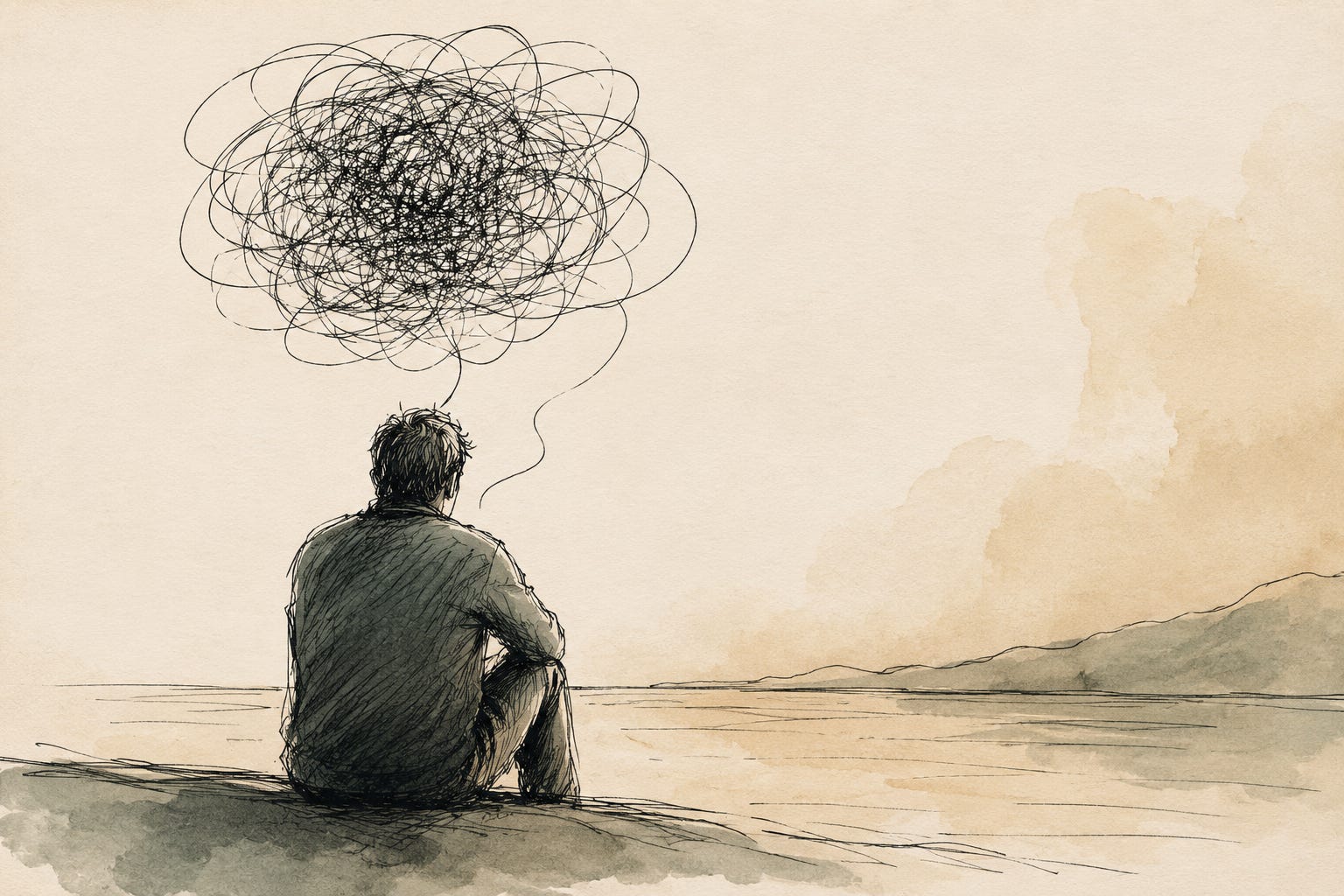
Caring without keeping watch
So now I'm trying to ask more and guess less. More importantly, I'm looking for the delineation between what is mine to carry and what is theirs.
If I'm not sure whether someone wants to talk, I ask them, and if there's something practical I can actually do, I offer it. When the answer's no, I'm learning to leave it there instead of quietly looking for another angle in.
I'm also getting better at letting a bad day just be a bad day. Someone going through a hard time still gets tired, still gets irritated, and still just doesn't feel like talking sometimes, and not every mood needs a full investigation. What's more, not every mood is for me to change or mirror.
Written out like that, it sounds obvious, but it's taken me a lot longer to actually live it.
The harder part has been letting myself get on with my own life while someone I love is struggling. I'd be at work, or on the golf course, or laughing with mates, completely fine, and then it would hit me that I hadn't thought about them in a couple of hours, and the guilt would land straight away.
Somewhere along the way I'd started treating worry as proof that I cared, but carrying someone else's pain around all day doesn't take any of it off them. It just means two people are having a bad day instead of one, and that helps nobody.
Finding the line again
There are likely to be many ways of reclaiming your boundaries in the situation I find myself in. However the most simple and effective I’ve found is in the form of somatic connection exercise suggested by my Life/Executive Coach;
I put one hand on my chest, the other on my stomach, slow my breathing down, and remind myself of three things: I care about this person deeply, their journey is theirs, and my own wellbeing still counts too.
It's a way to show empathy, but with a healthy reminder of what is theirs and what is mine to carry. I felt a bit lame the first couple of times I did the exercise, not going to lie, but it actually works and I now find myself repeating these words numerous times a day. It breaks whatever loop I'm running and pulls me back to what I actually know, rather than what I've read into a text message, a look on someone's face, or a tone in their voice.
I still get this wrong sometimes, I still overthink a conversation now and then, and the instinct to fix things hasn't gone anywhere either. I don't think it ever will completely. I just catch it sooner now.
I’d always assumed that being more emotionally intelligent simply meant having more empathy, period. I still think empathy is core, but what's changed is the idea that there's no ceiling on it. Without a boundary around it, empathy can leave you anxious, hyper-alert, and far too invested in decoding someone else's inner state, with no real benefit to you or them.
Sometimes loving someone means knowing where their feelings end and yours begin. That distinction doesn’t make you care less. It puts you in a better position to truly help.