


A fresh start changes where you are or the company you keep, but it doesn’t change what comes with you.
When you change jobs, move location, start a relationship, things look different, whether that’s the environment, the people, or both. Fresh environments and new people are usually blind to your history and, especially in the early stages of change, have little insight into your thoughts and beliefs. For a while, old problems seem further away because daily life no longer looks the same, but what’s inside your head, or what you carry, so to speak, rarely changes at the same speed, if at all.
Moving to Brisbane, near-on thirty-years ago, taught me this long before I understood it. Nobody knew Monica or I when we moved north from Melbourne in our early twenties, and being unknown felt good. It was the fresh new start that we had sought. We arrived in Brisbane on money borrowed from our parents and without jobs or a permanent place to live. It was the new-life trifecta; we were young, far from home, and starting from scratch.
Whilst the feeling of a fresh start buoyed me initially, what I failed to understand was how much of my old thinking had travelled with me. The 1650-kilometre journey changed the geography, but I still worried incessantly about what people thought, criticism sat long and heavy on my mind, and under pressure, I fought harder than most for resilience. Back then, none of this looked like a pattern or a problem. In fact, some of those traits even felt like strengths, and perhaps they were, but on balance, they were growth-limiting.
Principle 3 of The Way Through cautions us to know what you carry, or you will keep bringing old thoughts, beliefs, and responses into new situations.
Experience leaves marks on how we think, shaping our beliefs, thoughts, and responses. Praise, criticism, failure, and fear, among countless others, shape the way we process things, building our beliefs and our routine reactions. Over time, certain responses feel less like choices and more like personality. We carry these constructs within and, as obvious as it may sound, they move travel with us, regardless of the people and environments around us.
Growth and recovery are built on the understanding that unless we deliberately unpack and understand the beliefs, thoughts, and responses that we carry, they remain with us and will travel wherever we go. Changing our location or the company we keep will never change the patterns that’ve formed within us. Sure, the fresh faces and fresh environment may create better circumstances for change, but in isolation they will not change long-held mental constructs and behaviours.
Does this mean every old belief, habit or response needs to be fixed before change or recovery have any chance of working? Not at all. That would set an impossible standard and miss the point of this principle.
Awareness of all that we carry is enough to begin. Once you recognise the beliefs, thoughts, and behaviours you carry, you have a better chance of noticing when and how those old responses are taking over. With awareness, you create a small gap between what happens and what you do next, and in that gap sits choice, the choice to grow.
Without that awareness, we unpack the same thoughts and responses wherever we go, even when they no longer serve your growth or recovery.
Take someone who struggles with criticism at work. They feel singled out, believe feedback is unfair, and eventually leave because the workplace feels like the problem. A new role brings relief; the manager and team are different and the old tension disappears.
For a while.
Then feedback arrives, and the same discomfort returns. Comments again feel personal, and the person again becomes defensive or starts questioning whether they are being treated fairly. Before long, the new workplace feels a lot like the old one, because despite the new people and new environment, they are still carrying the same mental constructs as thoughts, beliefs, and responses.
Perhaps both managers were poor communicators, or perhaps some of the criticism was unfair, but if the same reaction keeps appearing with different people in different places, the environment might only explain part of the problem.
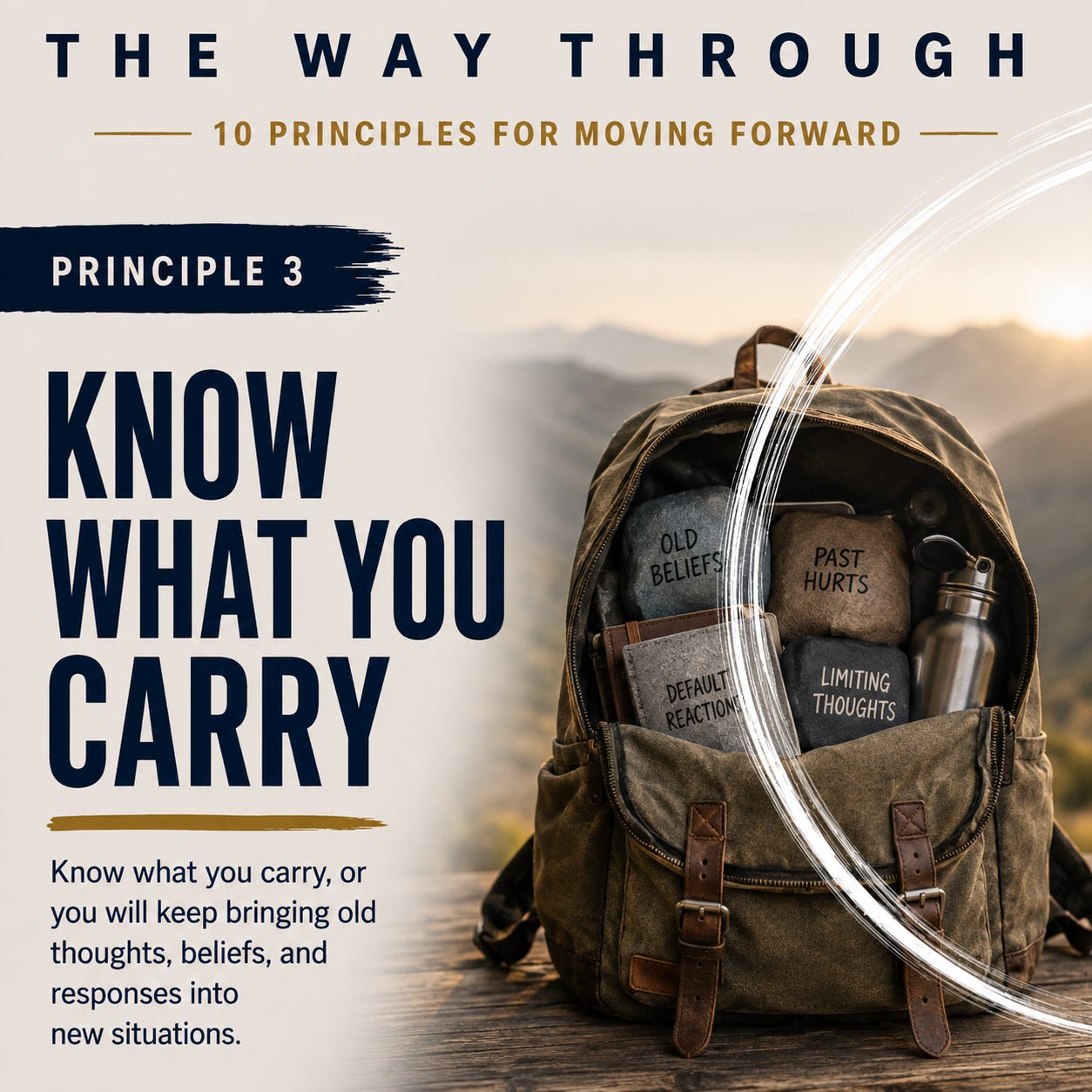
This is where Principle 3 becomes useful. You start asking whether the response in front of you belongs entirely to the present moment, or whether some of it was formed somewhere else. Old lessons have a long life when we don’t question them. The lesson itself is not the problem, the trouble starts when we keep applying that old lesson to situations where it no longer fits.
What keeps happening and how do I usually respond?
Where did I learn to respond this way?
And, most importantly, does this response still serve me now?
The answers are rarely clear, and most patterns only surface once the moment has passed and the emotion has settled. I’ve stopped worrying about spotting every pattern straight away, instead, I pay attention when one becomes obvious. When it does, I’ve found it’s worth taking the time to unpack it and understand what it’s trying to tell me.
Sometimes progress is as small as catching yourself a little earlier than last time.
However, not everything we carry needs to be left behind. Experience gives us useful things, like better judgement or healthy scepticism. So, it’s not about erasing your past, rather it’s about unpacking and understanding it to decide what serves you.
We should keep what still helps but question what repeatedly gets in the way of growth.
Perhaps staying quiet once kept you out of conflict, but now it stops you saying what needs to be said. Relying on yourself might have been necessary when other people were unreliable, yet years later the same independence makes asking for help harder than it needs to be.
Every construct we carry has history, but they don’t all deserve a future. Several of mine felt like fixed parts of my personality for years. I believed working harder was nearly always the answer. I thought solving problems myself showed strength and taking responsibility felt safer than relying on others. Those beliefs helped me in plenty of situations, but I also carried them for too long.
Knowing what you carry doesn’t mean living in the past. On the contrary, you only need to look back enough to understand what keeps turning up today, then turn your attention towards what you want to do next.
Nearly thirty years ago when we arrived in Brisbane we didn’t own much and there was very little to be unpacked save for a bed, television and a few boxes of clothes. With the benefit of hindsight I now see there was much more to be unpacked and it was far more important than the second hand television and our summer wardrobe. I had two decades of learnings and constructs that’d previously served me, but would need reconsideration if I was to grow into our new life.
You don’t need to unpack everything and you certainly don’t need to do it all at once. You just need to unpack before deciding what to keep carrying.
Beautifully said. A fresh start can offer new scenery, but it cannot do the inner unpacking for us. My personal work is learning to distinguish hard-earned wisdom from old protective wiring. When I notice an old pattern before it takes the wheel, I create a small but consequential space—enough space for a different future to even maybe become possible.