


By the age of 20, I felt beaten, with nothing to offer a world which held nothing for me. Dogged by depression, often aggravated by heavy drinking, I’d found no relief in any of the help offered to me.
Thirty years on, I’ve had the privilege of being a husband for over 24 years and a father for the last twenty. I’ve been sober for over 19 years, and in parallel to this blessed personal life, I’ve carved out a career as a successful leader in financial services, while giving a little of my time to so amazing community-centric causes.
Those two points in time, albeit three decades apart, could hardly look more different, both from the outside and in how I see myself. Getting to where I am today has taken conscious effort but has been underpinned by a series of truths I am now documenting as The Way Through 10 Principles of Moving Forward.
In my forthcoming book, The Way Through, I chronicle the extreme lows of my late teens and early twenties, coupled with my desperate search to find a way out. The Way Though 10 Principles of Moving Forward are ten truths I discovered through the lived experience of the following three decades, while I came to realise it was a way through that I needed, not a way out.
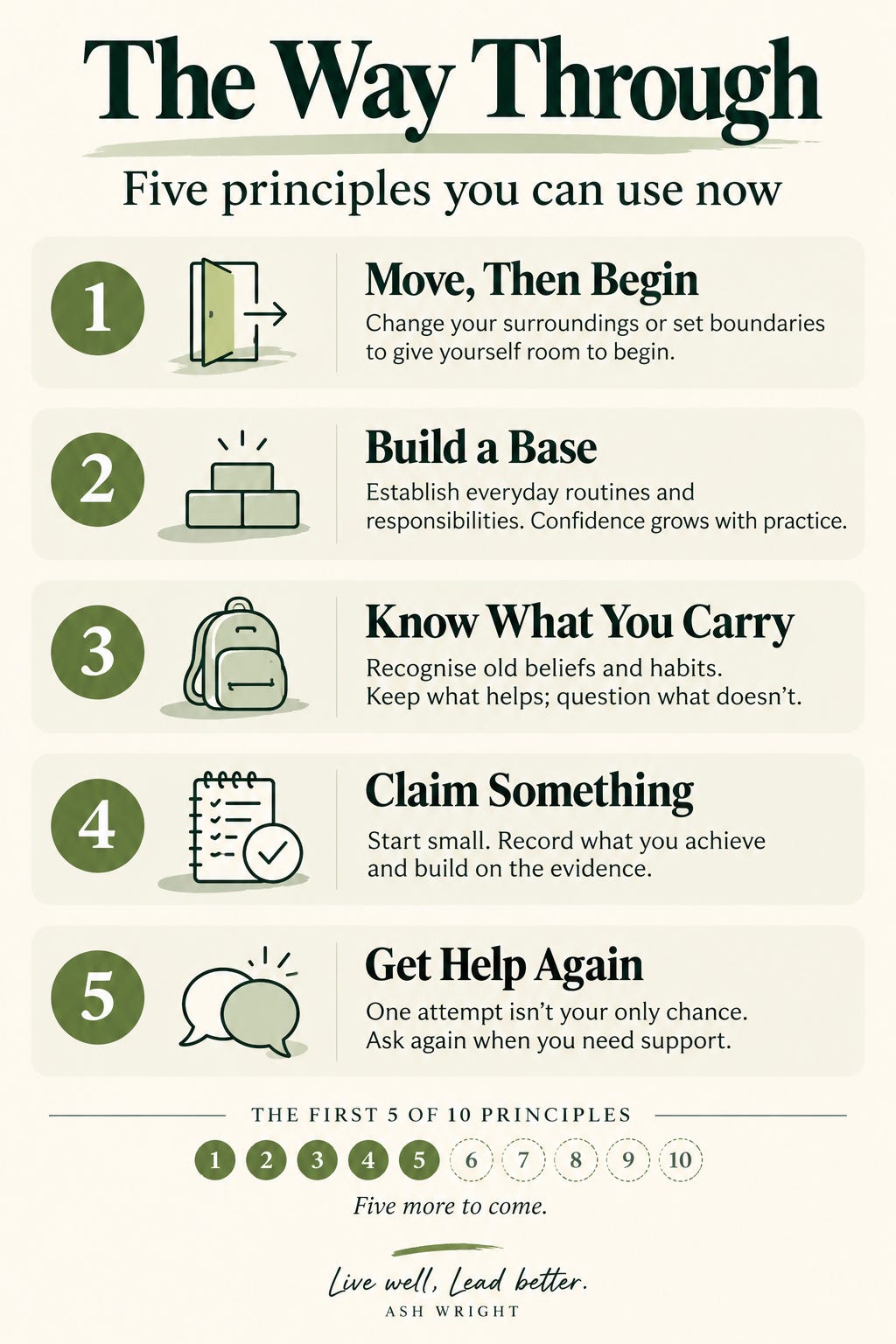
Recently I’ve been writing about the first five principles, which can be used in whole or part and in any order. In readiness for the final five truths, which I’ll publish over the coming couple of months, I thought I’d summarise the first five and demonstrate how they can help in finding the way through personal and career growth, self-awareness and recovery.
These principles can be used individually or together, in whatever order makes sense for you. The numbering follows the order in which they revealed for me; you might start with the fifth or return to the second several times. It really doesn’t matter, take what you need and leave the rest, it’s your journey through.
1. Move, Then Begin
Move, Then Begin simply comes first because that’s how it happened for me, no other reason. Coincidentally though, mentally or physically moving to create space for growth is often key in early growth or recovery. For me, leaving old surroundings gave me room to change the habits and thoughts I’d carried with me, and to build a different life and career.
Sometimes we expect ourselves to recover and grow while staying in surroundings that keep resurfacing painful memories or rewarding the very behaviours that have prevented our success. Changing where we spend our time, or the routines that keep taking us there, can give us room to begin.
For me, move, then begin meant leaving Melbourne and moving to Brisbane. In Melbourne, too much around me reminded me of old situations, and I found it hard to change while those reminders punctuated everyday life. Moving gave me some distance and a chance to establish different routines. I still had to work through what I’d brought with me, but I had more room to do that.
You may need to move physically, or the change may simply involve setting boundaries for yourself and with others. Being clearer about what you’ll accept from people, and recognising when your own choices keep taking you back into old habits, can help you make better use of the space you already have.
It matters less how you create the space and more that you create it, for growth and recovery without space is infinitely harder.
2. Build a Base
Build a base is about getting the simple things in place before tackling the bigger ones.
When we’re trying to move forward, it’s tempting to focus on where we want to end up. We want to feel confident again, make progress and see some evidence that our lives are changing. But often, the most important work happens long before any of that becomes obvious. It’s in the ordinary things we do each day, the routines we establish and the responsibilities we learn to manage.
I learnt this when Monica and I moved to Brisbane. We found jobs and rented a modest townhouse, paid bills and did the grocery shopping. None of it felt remarkable and I remember wondering when our new life was going to begin.
Looking back, it already had.
We were building our base in those ordinary weeks and amongst those mundane things. We were taking responsibility for ourselves, establishing routines we could manage and creating a life that was increasingly dependable. The small, everyday responsibilities were giving us something solid to build on.
The same principle applies in other parts of life. Starting a new job, for example, can feel overwhelming when you think about everything you need to learn and achieve. But as you get comfortable with the basics and learn what’s expected of you, the everyday work becomes easier. Problems that initially seemed difficult become familiar, and tasks that once required all your concentration become second nature. Slowly, you find yourself ready to take on more.
You don’t have to feel confident before you build something better. Sometimes confidence develops from doing the ordinary things consistently until one day you realise just how much you’ve built.
3. Know What You Carry
Know what you carry is about recognising that what we do today is often shaped by what happened in our past. Our thoughts, actions, reactions and habits don’t come out of nowhere. They’re grounded in old experiences.
Moving forward requires an inventory of what we’re still carrying. Some of it still serves us, but some of it doesn’t.
For me, a mix of experiences when I was young left me believing that I hadn’t always earned my place in the world, that somehow I was inferior to others. Those beliefs shaped how I saw myself and how I behaved. When I started to look at what I carried and question those old assumptions, I could see which ones no longer served me and began to change them. That gave me a chance to reshape what came next.
You can’t change what you carry until you recognise that you’re carrying it and sometimes understanding the past is exactly what allows us to stop repeating it.
4. Claim Something
Claim something is about gathering evidence. Small, tangible achievements give you something to point to and say, ‘I did that’, instead of relying on telling yourself you’re capable and hoping you’ll believe it. Each small achievement might seem insignificant on its own, but as you gather more and build on them, they change the story you tell yourself about what you can do.
The idea of claiming something is to start small enough that you can succeed. Claim that small thing, then build on it. Over time, those individual pieces of evidence give you enough confidence to reach for something bigger, something that once might have seemed impossible.
I learned this one when I decided I wanted to run a marathon, I couldn’t even run short distances, so I started with what I could do and kept a running log. Every run went into it and as I ran a little further or for a little longer, the evidence grew.
Eventually, all those small pieces of evidence added up. I could run five kilometres because I’d done it, and in time I could say the same about ten. Each distance gave me something new I could claim as mine. Then on 7 August 2016, I crossed the finish line of the Brisbane Marathon.
The marathon was a bigger achievement I could finally claim because I’d built the confidence to attempt it, kilometre by kilometre, through all the smaller distances I’d already run.
5. Get Help Again
Contrary to what we may think, asking for help can be a habit for growth rather than a one and done thing. Get help again emphasises that asking for help once doesn’t mean you’ve exhausted your options.
We often treat asking for help as though we only get one attempt. We reach out, take someone’s advice or try something different, and if it doesn’t get us where we hoped, we give up. Asking again can feel like admitting the first attempt failed or, worse still, that we failed to get it right.
Asking for help a second, third or fourth time is still forward movement.
I learnt this through my experience with anxiety. In my early twenties, I was dealing with significant anxiety alongside depression. I’d asked for help, but the help I received the first time didn’t really hit the mark, and the anxiety remained.
For a long time, I was reluctant to ask for help again. Part of me saw needing more help as an admission of failure. I told myself that perhaps I hadn’t tried hard enough or that I should’ve been able to make the initial advice work. I worried that needing to go back again meant there was a weakness.
Eventually, I asked for help again by asking someone else. They brought a different perspective, and slowly I understood my anxiety and was able to change the way I responded to it.
Over nearly thirty years, I’ve returned for help with my anxiety several times, drawing on different people’s perspectives at different stages of my life. Each time, I’ve learnt something else about myself and improved, little by little, the way I respond and cope.
The fact that the first answer didn’t get you where you needed to go doesn’t mean you failed. You may need another answer, so ask again.
But do they really work?
I’ve made these principles work for me across three decades of life and career, often using more than one to deal with the same difficulty and returning to some several times. They support one another, but there’s no fixed starting point and it’s a matter of progress over perfection.
I’ll share the final five principles over the coming months. For now, choose the one that fits what’s getting in your way and write what applying it would involve this week. After you’ve tried it, look at what helped and what still needs attention, then decide whether to keep working with that principle or bring in another.
I spent years looking for a way out of my difficulties. These principles helped me build a better life by finding my way through.